
| 14 May 2026
Generative AI is already being used across healthcare. The challenge facing organisations now is not whether adoption will happen, but how to ensure it happens safely, responsibly and in ways that genuinely support staff and patient care.
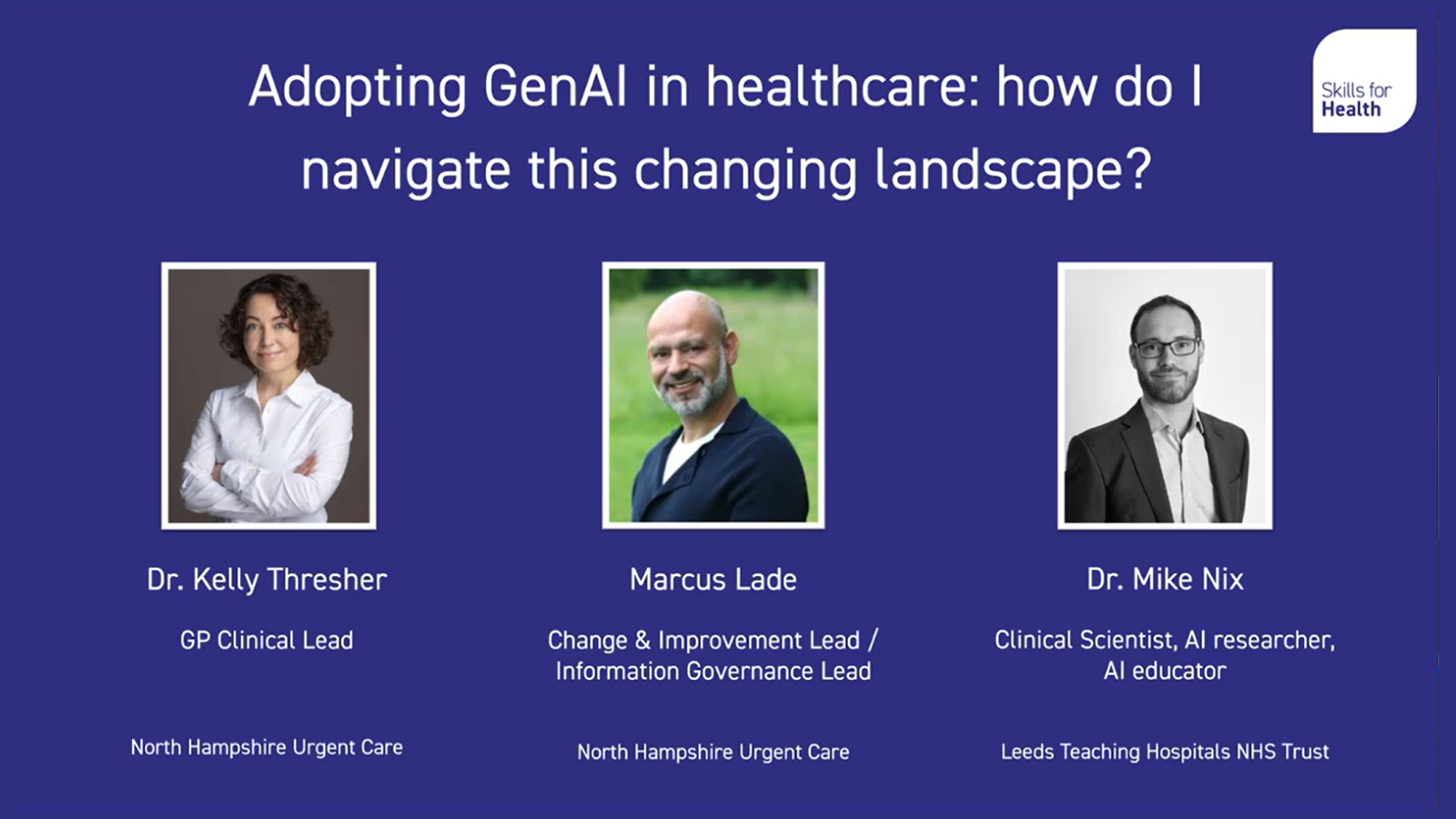
In our recent webinar, Adopting GenAI in healthcare: how do I navigate this changing landscape?, we brought together healthcare leaders working at the forefront of GenAI adoption, governance and clinical implementation to explore the realities of navigating this fast-moving landscape in practice.
The discussion moved beyond theory and broad frameworks, focusing instead on the practical challenges organisations are already facing: from informal “shadow AI” use and workforce confidence to risk, accountability and safe implementation.
Watch the webinar on demand
Key themes explored
GenAI use is already happening across healthcare
A clear theme throughout the discussion was that many healthcare professionals are already using GenAI tools in day-to-day practice – often informally and sometimes outside established organisational structures.
The panel explored how this creates both opportunity and risk. While GenAI can support productivity, communication and administrative efficiency, organisations also need environments where staff feel able to discuss its use openly, enabling leaders to ensure tools are being used safely and appropriately.
As Dr Kelly Thresher, IUC GP Clinical Lead at North Hampshire Urgent Care, highlighted during the session, the conversation is no longer simply about whether clinicians should use GenAI, but how organisations can support them to do so safely, responsibly and within appropriate legal and professional boundaries.
Balancing innovation with responsibility
The discussion also explored the pressure many organisations feel to adopt GenAI quickly while navigating evolving regulation, clinical accountability and information governance considerations.
Marcus Lade, Change & Improvement Lead / Information Governance Lead at North Hampshire Urgent Care, shared practical insights into implementing AI tools safely within healthcare settings, including ambient scribe technologies and consumer GenAI tools.
A key message throughout was that successful GenAI adoption starts with understanding the tools being introduced, including how data is handled, where it may be retained, and the boundaries of approved use. The panel emphasised that safe adoption depends not just on technology, but on culture, leadership, workforce confidence and good organisational judgement — all underpinned by clear guidance, education and training.
Understanding risk, confidence and workforce capability
Dr Mike Nix, Clinical Scientist and AI Researcher at Leeds Teaching Hospitals NHS Trust and the University of Leeds, brought valuable perspective on confidence, uncertainty and safe clinical decision-making when integrating AI into healthcare workflows. Drawing on his work exploring the AI skills and workforce capabilities needed across UK healthcare, he highlighted the importance of workforce understanding, critical thinking and realistic expectations in supporting safe GenAI adoption.
The panel discussed how organisations need staff who understand both the capabilities and limitations of GenAI tools, alongside the importance of maintaining critical thinking and human oversight.
This reinforced a wider theme across the session: safe AI adoption is not solely a technical challenge – it is also a workforce and education challenge.
Speaker highlights
Marcus Lade – Change & Improvement Lead / Information Governance Lead, North Hampshire Urgent Care
Marcus leads digital transformation and information governance, driving safe AI adoption at scale. From GenAI tools to ambient scribe technologies like TORTUS, his work focuses on improving patient pathways with measurable impact.
Dr Kelly Thresher – IUC GP Clinical Lead, North Hampshire Urgent Care
Kelly oversees clinical quality, workforce support and service development across complex care environments, bringing frontline insight into the realities of GenAI use in clinical practice.
Dr Mike Nix – Clinical Scientist & AI Researcher, Leeds Teaching Hospitals NHS Trust & University of Leeds
Mike leads AI implementation in Medical Physics and Clinical Engineering. As a Clinical Fellow for AI & Workforce, he has worked with Health Education England and the NHS AI Lab, focusing on risk, confidence and safe clinical decision-making using AI in real-world settings.
Supporting safe GenAI adoption across the workforce
As GenAI becomes increasingly embedded within healthcare settings, organisations need practical ways to build workforce confidence and support safe day-to-day use.
Our short eLearning course, GenAI in Healthcare: Starting Safely, has been designed to help healthcare staff understand how to use GenAI responsibly, safely and lawfully in workplace settings through realistic healthcare-focused scenarios.
Explore the course
We also offer organisational licences and volume discounts for healthcare providers looking to support safe and consistent GenAI adoption across teams.
Navigating the future of GenAI in healthcare
One thing the webinar made very clear is that there is no single “right” approach to GenAI adoption – whether organisations choose to move now or wait for further regulatory clarity. What is clear, however, is that the pace of GenAI adoption across healthcare continues to accelerate regardless, and safe implementation depends on far more than technology alone.
Leadership, workforce understanding and training, proportionate guidance, and open conversations will all play an essential role in shaping how GenAI is adopted safely and responsibly across the sector.
Thank you again to everyone who joined the session and contributed to the discussion.