
| 22 December 2025
Why the next evolution of statutory and mandatory training isn’t about chasing innovation, but choosing it wisely
For years, statutory and mandatory eLearning in health and social care has carried a familiar reputation: click-through modules, repetitive slides, and assessments that test recollection rather than real-world competence. In many organisations, mandatory training has become a necessary chore – a quick, cost-effective way to meet regulatory requirements rather than an opportunity to build capability.
But digital learning has evolved dramatically. With AI, simulation, adaptive learning and advanced analytics reshaping expectations across the sector, the conversation is no longer about whether technology can transform compliance training; it’s about how to use it wisely.
The future of healthcare compliance eLearning is not dictated by the newest technological trend. Instead, it depends on finding a sustainable balance: blending innovation with practicality, and pairing AI-enabled personalisation with credible, expert-developed content that remains affordable, scalable and aligned to NHS and UK regulatory requirements.
This shift brings us to a crucial question: which innovations genuinely strengthen compliance learning, and which simply add unnecessary complexity or cost?
1. Immersive technologies are rising, but they’re not always realistic for compliance
Virtual reality (VR), augmented reality (AR) and AI-driven simulation are transforming clinical education, particularly in areas such as surgical training and patient communication. Growing evidence, including narrative reviews on the combined impact of AI and VR in healthcare education, shows that immersive technologies can improve decision-making accuracy, behavioural engagement and learner confidence in high-pressure scenarios.
However, outside specialist training environments, full immersive simulation is often impractical for statutory and mandatory compliance learning. Key barriers include:
- High hardware and development costs
- Specialist resources required
- The need to train thousands of staff consistently
- Mandatory refresh cycles demanding repeatable, low friction delivery.
The future of compliance eLearning lies in targeted, lightweight experiential learning, not blanket adoption of high-end simulation.
Practical, scalable experiential learning includes:
- Branching scenarios
- Narrative-driven decision pathways
- Reflective case studies
- AI-powered micro-simulations
- Scenario-based conversations (e.g. safeguarding, conflict resolution).
This offers realism and relevance without prohibitive cost – the practical, scalable middle ground the sector needs.
2. The evolving role of gamification in healthcare compliance
Gamification continues to expand across digital learning, but its role in healthcare compliance eLearning is more nuanced than in many other sectors. Traditional gamification approaches – such as points, badges and leaderboards – are rarely appropriate for statutory and mandatory training, particularly where content relates to clinical safety, safeguarding or regulatory compliance.
That said, gamification does have a place in healthcare compliance learning when it is applied with care and intent.
Evidence increasingly shows that game-informed learning design, when aligned to clear educational objectives, can significantly improve learner engagement, motivation and knowledge retention. In nursing and medical education, gamified approaches have been shown to increase interaction with learning materials and support stronger learning outcomes – especially when learners are guided through realistic choices and consequences rather than competitive scoring systems.
Research into gamified VR and simulation-based learning also highlights improvements in teamwork and clinical reasoning, reinforcing the value of experiential, interactive learning in high-stakes environments when it supports – rather than distracts from – core learning goals.
In the context of statutory and mandatory healthcare training, the most effective applications of gamification are therefore subtle and purposeful. Instead of competition, modern healthcare eLearning focuses on:
- Interactive, branching decision pathways
- Narrative-based clinical and safeguarding scenarios
- “Choose what happens next” sequences that encourage reflection
- Subtle progress indicators that support motivation without distraction
- Safe exploration of clinical and ethical consequences.
Used in this way, gamification brings energy and momentum to training that has traditionally felt repetitive or cognitively draining. More importantly, it helps sustain attention – a critical factor in improving completion rates, strengthening retention, and supporting confident, audit-ready compliance across the healthcare workforce.
3. AI is transforming compliance eLearning, but scale doesn’t equal quality
Over the past year, advances in generative AI have fundamentally changed how eLearning content is created. Tasks such as researching subject matter, drafting learning materials, designing learning journeys and generating assessments – once requiring weeks of effort from multiple teams – can now be produced rapidly by individual designers.
As a result, AI-generated learning content has become commonplace. However, as adoption accelerates, the focus has increasingly shifted toward production speed and scale – even though, in healthcare compliance learning, success is not measured by volume but by whether content genuinely supports understanding, confidence and safe, real-world practice.
AI is most effective in this context when it simplifies and supports learning, rather than adding complexity. Used thoughtfully, AI can adapt learning pathways so that experienced staff move quickly through familiar content, while newer or less confident learners receive additional guidance and reassurance. Shorter, targeted modules and lightweight, AI-powered scenario prompts can add relevance and context without increasing cognitive load.
Crucially, these benefits can be delivered without the cost or infrastructure demands of large-scale simulation, making AI well suited to statutory and mandatory training delivered at scale across the NHS and wider health and social care sector. That said, restraint remains essential. Over-engineered AI interactivity can extend course duration and overwhelm learners – the opposite of what is needed in time-pressured clinical environments. The value of AI in compliance learning lies not in how much it can do, but in how selectively it is applied.
Where AI needs careful boundaries in compliance learning
Emerging evidence highlights several areas where caution is needed:
- Assessment accuracy and trust: AI-generated assessments can introduce ambiguity or perceived unfairness when interpreting complex responses, undermining confidence unless reviewed by subject matter experts.
- Cognitive load and design quality: Multimodal AI content – including synthetic voices and avatars – can either enhance or overwhelm learning, depending on instructional design, making intentional design far more important than novelty.
- Governance and consistency: Gaps in policy, ethical guidance and standards for AI use can lead to uneven implementation and uncertainty across organisations.
- Human judgement for sensitive topics: Research shows learners place greater trust in human or co-produced guidance for complex, ethical or emotionally charged subjects, where context and nuance matter most.
Taken together, these findings reinforce a clear principle: AI is most effective in compliance learning when it supports human expertise, not when it attempts to replace it.
4. Compliance eLearning must balance innovation with practicality
Compliance programmes operate under unique constraints. They must be affordable, repeatable every one to three years, scalable across large and diverse workforces, and quick to complete – without compromising quality or safety. This is why the most effective compliance eLearning solutions prioritise balance, applying innovation where it adds value, while maintaining practicality for system-wide delivery.
Crucially, impactful compliance learning does not need to be expensive or technologically complex. High-quality, engaging statutory and mandatory training can be delivered through:
- Realistic, scenario-based examples
- Role-relevant content tailored to different staff groups
- Expert-led case studies grounded in real healthcare practice
- AI-enhanced adaptivity to personalise pace and depth
- Interactive knowledge checks that reinforce understanding
- Multimedia development with subject matter experts (SMEs).
Together, these elements elevate learner engagement and competence without relying on VR headsets, specialist hardware or costly simulation infrastructure. The result is effective, scalable compliance training that respects both learner time and organisational constraints.
5. The hidden cost of “free” compliance training
Free or super low-cost compliance training can appear attractive, particularly in a financially constrained healthcare environment. However, it often comes with trade-offs that are not immediately visible:
- Generic content or limited alignment to national frameworks
- Minimal interactivity and lower learner engagement
- Weaker analytics or poorer audit readiness.
When viewed alongside The NHS Patient Safety Strategy and findings from studies such as ‘Uncovering MOOC Completion: A Comparative Study of Completion Rates from Different Perspectives’ and ‘Learning Analytics on Student Engagement to Enhance Students’ Learning Performance: A Systematic Review’, a consistent pattern emerges. Low-barrier, free learning offerings frequently record single-digit completion rates and lower engagement, while well-designed, clinically informed training content is associated with stronger competency development and reduced compliance risk.
In high-stakes healthcare settings, this reinforces a familiar principle: you get what you pay for.
In practice, poorly designed “free” solutions can lead to increased repeat training, slower completion times, weaker retention, higher organisational risk and greater long-term cost. This is not to suggest that high-quality free resources do not exist – many do – but in statutory and mandatory training, value is determined by quality, credibility and learner experience, not price alone.
6. Data proves it: Better design delivers better compliance outcomes
Across Skills for Health’s datasets, approximately 66% of learners complete a course in a single sitting, 22% return twice, and the remainder revisit multiple times. Crucially, learners who return to a course take, on average, 60% longer to finish it – and often retain less.*
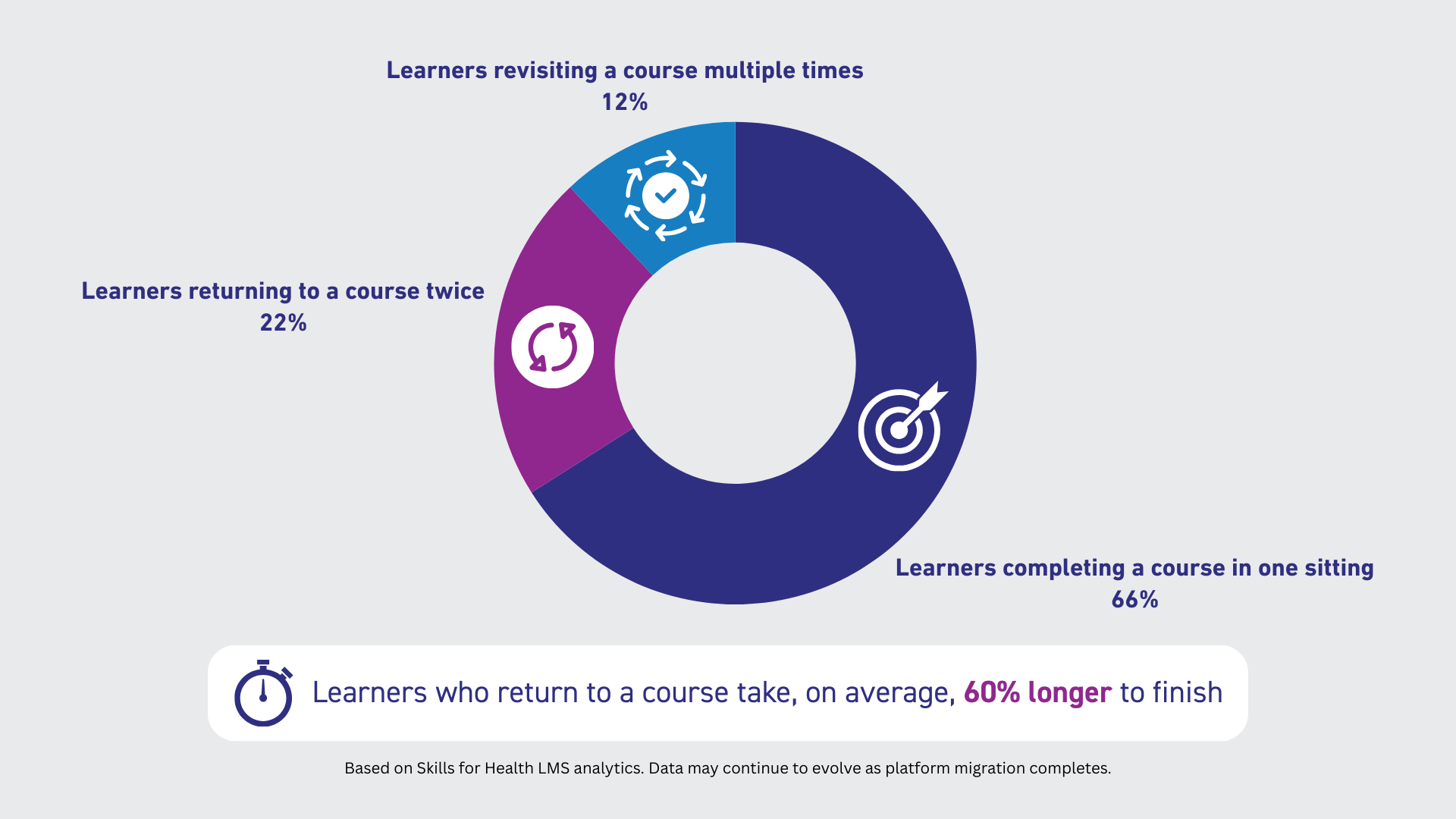
This insight is telling. It suggests that completion and retention are not driven by how technologically advanced a course is, but by how well it is designed to fit real working patterns, attention spans and time constraints.
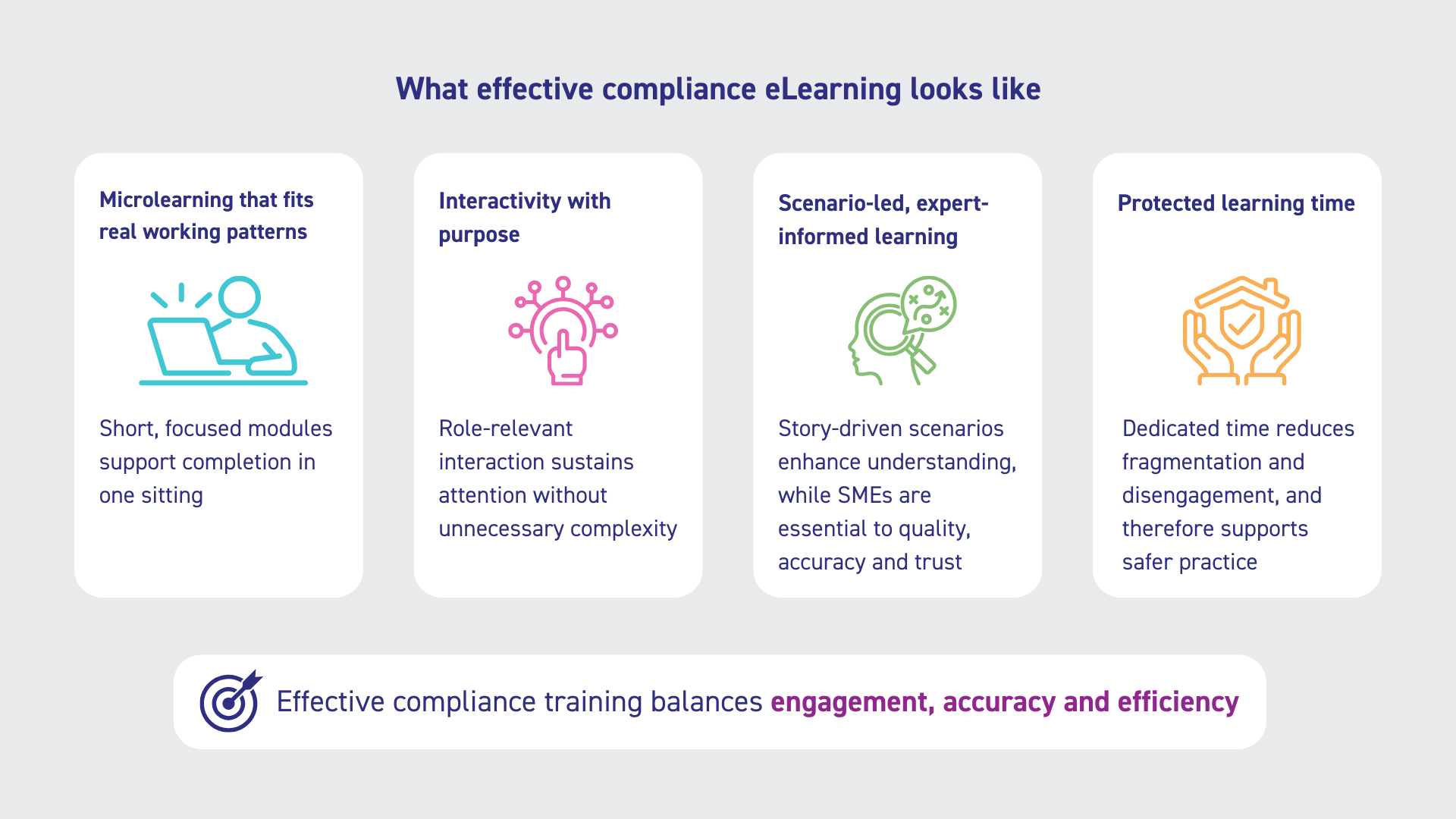
These patterns in learner behaviour reinforce the importance of:
- Microlearning and shorter modules that support completion in one focused sitting.
- Interactivity and role-specific relevance to sustain attention without unnecessary complexity.
- Story-driven, scenario-based design that strengthens understanding and recall.
- Protected time for statutory and mandatory training to reduce fragmentation and disengagement.
Organisations that formally timetable learning time are more likely to achieve faster, more reliable compliance and stronger knowledge retention, by giving staff the opportunity to complete training in one focused sitting rather than fragmented sessions.
* Please note: these insights reflect December 2025 platform analytics and may continue to evolve as Skills for Health completes its LMS upgrade. As more customers migrate to the enhanced learning platform, expanded datasets may further refine these findings.
7. Expert-led content remains healthcare’s most reliable compliance asset
Even as AI and simulation advance, the strongest foundation of effective compliance training remains:
- Clinical accuracy
- Policy alignment
- Regulatory expertise
- SME input
- Real-world healthcare insight.
Skills for Health has a unique and sector-leading role in this. Beyond delivering eLearning, Skills for Health is the author of the UK’s Core Skills Training Framework (CSTF) – the national benchmark for statutory and mandatory training – and a co-developer of the Care Certificate, the widely adopted induction framework for the health and social care workforce.
This means Skills for Health’s eLearning is built from the same evidence base and clinical stewardship that drive the sector’s most recognised national standards. It is not just content creation, but fully framework-aligned training grounded in expertise, accuracy and safety – reducing risk where it matters most.
The most sustainable future for compliance training is not “technology instead of expertise,” but technology and expertise working together.
What 2026 means for the future of compliance eLearning
Mandatory training is evolving from a tick-box exercise into a more relevant and engaging learning experience. Looking ahead, the sector can expect continued investment in:
- AI-powered, scenario-based microlearning
- Smarter blended learning pathways
- Early warning analytics for learner support
- Role-specific compliance pathways
- Framework-aligned, expert-developed content.
Compliance eLearning may never be eagerly anticipated, but it is becoming more meaningful – with better design, more learner-led experiences and thus stronger outcomes, all while preserving the cost-efficiency essential for large-scale delivery.
Skills for Health: High-quality, evidence-based compliance eLearning
As the NHS and wider healthcare sector continue balancing innovation with practicality, Skills for Health remains committed to delivering clinically accurate, expert-led, framework-aligned compliance training that strengthens competence, supports safer care, and reduces training fatigue – without unnecessary cost or technological complexity.
Not every emerging technology will have a practical, cost-effective place in statutory and mandatory training, but Skills for Health proves that compliance eLearning can still be scenario-led, data-informed and expert-driven, offering a learning experience that is trusted, reliable and reflects the realities of modern healthcare work.